
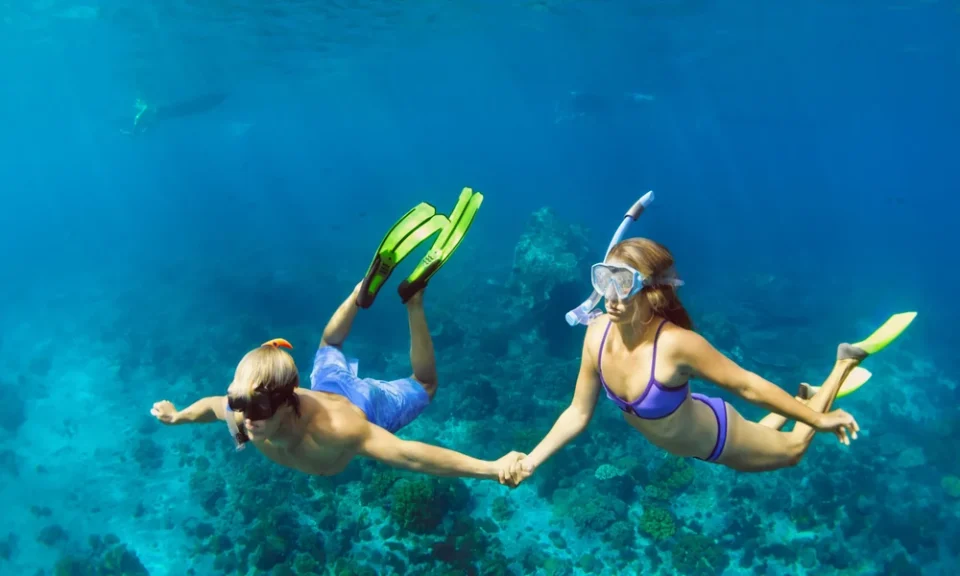
The Caribbean sits above some of the most diverse and accessible marine ecosystems on the planet. Coral reefs, sea turtles, rays, nurse sharks, and schools of fish in colors that don’t seem real until you’re looking at them – the underwater world here rewards anyone willing to get below the surface. The question of how far below the surface is worth thinking through before you arrive, because snorkeling and scuba diving are genuinely different experiences that suit different people and different situations.
What Snorkeling Actually Offers
Snorkeling’s appeal is its accessibility. A mask, a snorkel, and fins are the only equipment required. No certification, no training beyond a brief orientation, no tank to manage or buoyancy to control. Anyone who can swim comfortably in open water can snorkel, and the barrier to entry is low enough that it’s available to almost everyone on a given trip – including children, older travelers, and people who have never done anything like it before.
What surprises most first-time snorkelers is how much is visible from the surface. Healthy shallow reefs in the Caribbean exist at depths of three to fifteen feet, close enough to the surface that the colors are vivid, the fish are close, and the overall experience is genuinely immersive. A good snorkeling site on a Caribbean cruise port stop – Trunk Bay in St. John, the reefs off Grand Cayman, the marine park at Curaçao – can produce an afternoon that stays with you longer than most shore excursions.
Freediving – holding your breath and diving below the surface – extends what’s accessible to a snorkeler and is worth learning if you plan to snorkel regularly. Even getting down five or ten feet to look at a coral head from the side rather than the top changes the experience considerably.
What Scuba Adds
Scuba diving opens access to a different category of underwater environment. The reefs that begin at forty feet and extend to a hundred, the walls that drop into blue darkness, the wrecks that sit too deep for a snorkeler to reach – these require a tank and the training to use one safely.
The sensory experience of scuba is also different from snorkeling in ways that are hard to articulate until you’ve tried it. Neutral buoyancy – the ability to hover motionless at any depth, eye to eye with a sea turtle or drifting past a coral wall – produces a quality of presence that snorkeling from the surface doesn’t replicate. The underwater world is three-dimensional in a way that only becomes apparent when you’re moving through it rather than floating above it.
The tradeoff is the investment required. Open Water certification – the entry-level scuba credential accepted worldwide – takes three to four days to complete and involves classroom learning, confined water practice, and open water dives. It’s genuinely worth doing for anyone with real interest in diving, but it requires planning ahead of a trip rather than deciding spontaneously at a port.
For travelers on a cruise who want to try scuba without committing to certification, a Discover Scuba Diving experience – a supervised introductory dive led by an instructor that requires no prior training – is available at most Caribbean dive shops and provides a real taste of what scuba offers. It’s not certification and doesn’t allow independent diving, but it’s a legitimate way to find out whether the full investment is worthwhile.
Choosing Based on Your Situation
A few honest questions help sort out which experience makes sense for a given trip and traveler.
How comfortable are you in open water? Snorkeling requires swimming comfort; scuba requires a higher baseline because you’re managing equipment, equalizing pressure, and operating at depth. Neither requires being a strong swimmer, but someone who is anxious in open water will have a better first experience with snorkeling than with scuba.
How much of the trip centers on the underwater experience? For travelers whose primary interest in a Caribbean destination is the reef and marine life, scuba certification before the trip is worth the effort. For travelers who want a memorable afternoon in the water among a broader itinerary, snorkeling at a quality site delivers that without any additional commitment.
Are there physical considerations? Scuba has medical contraindications – heart and lung conditions, certain ear and sinus issues, some medications – that don’t apply to snorkeling. Anyone with relevant health history should check with a physician before diving.
Equipment: Renting vs. Bringing Your Own
For snorkeling, bringing your own mask makes a meaningful difference in comfort and fit. Rental masks are shared, variably maintained, and sized for an average face – which may or may not be yours. A personal mask that fits well, seals properly, and has a clear lens costs relatively little and changes the experience noticeably. Fins can be rented without the same penalty; fit is less critical.
For scuba, most divers rent tanks and regulators locally and own only the personal items: mask, wetsuit, booties, and computer. It’s a reasonable split given the cost and bulk of the equipment.
The Bottom Line
Neither experience is better in an absolute sense – they’re suited to different people and different levels of engagement. Snorkeling done well at a quality site is a genuinely excellent experience. Scuba opens access to a wider and deeper world that rewards the investment in learning it. The best choice is the one that matches what you actually want from the water.
