
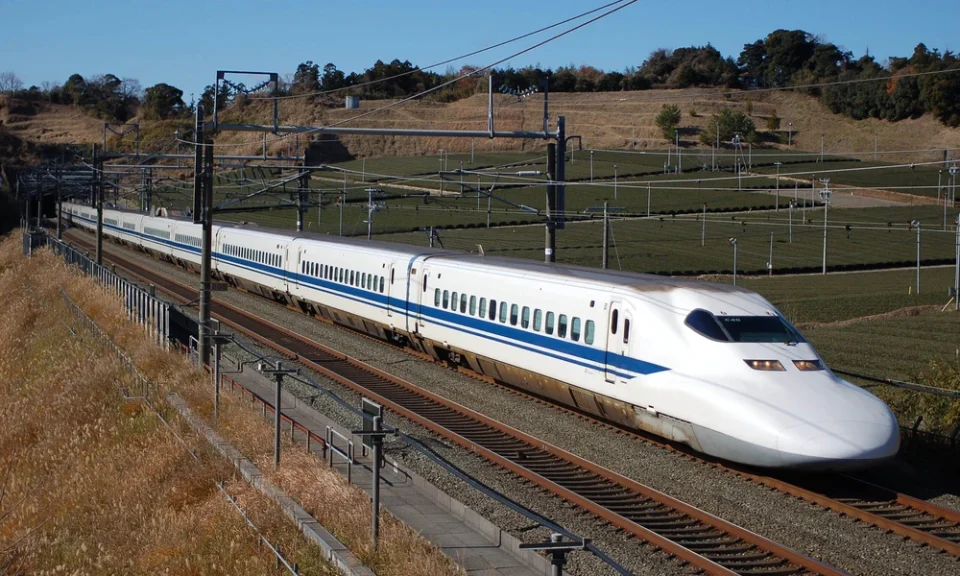
When Japan’s first Shinkansen line opened in 1964, timed deliberately to debut just before the Tokyo Olympics, it didn’t just introduce a faster train – it introduced an entirely new category of travel. At a moment when most of the world assumed air travel was the future and rail was a fading relic, Japan bet the opposite, and the bet paid off spectacularly. More than sixty years later, the Shinkansen remains one of the most influential transportation systems ever built, and it fundamentally changed how people move around the country.
A Bet Against the Trend
In the early 1960s, high-speed rail wasn’t an obvious priority. Cars and planes were rapidly becoming the default mode of long-distance travel across much of the developed world, and many transportation planners assumed traditional rail was on a slow path to irrelevance. Japan’s geography and population density made a different case: a narrow, mountainous country with major cities strung along a single corridor was, in some ways, close to an ideal environment for high-speed rail, if the engineering could be solved. The original Tokaido Shinkansen line, connecting Tokyo and Osaka, cut a journey that once took nearly seven hours down to about four, an improvement dramatic enough to reshape business and travel patterns almost immediately.
The Engineering That Made It Possible
Building a train capable of sustained high speeds required solving problems no rail system had faced before. Engineers used dedicated tracks entirely separate from conventional rail lines, eliminating the at-grade crossings and mixed freight traffic that limited speed elsewhere in the world. Wider rail gauges improved stability, while advances in aerodynamics, suspension, and braking systems allowed trains to safely operate at speeds that were, at the time, unprecedented for passenger rail. Perhaps most remarkably, the Shinkansen network has maintained a safety record with zero passenger fatalities from derailments or collisions since it opened, a statistic that becomes even more notable given Japan’s frequent earthquakes and the system’s exposure to typhoons.
Precision as a Design Philosophy
The Shinkansen’s reputation for punctuality has become almost as famous as its speed. Average delays across the network are measured in seconds per year rather than minutes, a level of precision made possible by dedicated tracks, extensive automation, and a deeply ingrained cultural emphasis on reliability. This precision isn’t incidental – it’s foundational to how the entire system was designed, from scheduling buffers to maintenance windows built into the operating model from the very beginning, rather than added on later as an afterthought.
Reshaping the Country’s Geography
The Shinkansen didn’t just make travel faster – it functionally redrew the map of which cities felt “close” to each other. Towns and cities that gained Shinkansen stations often saw measurable economic growth, as businesses and workers suddenly found day trips or short commutes to major economic centers feasible in ways that were previously unthinkable. This phenomenon, sometimes called the “Shinkansen effect,” has been studied extensively by economists looking at how high-speed rail access correlates with regional development, and it’s shaped decades of Japanese infrastructure and urban planning decisions since.
More Than Just the Tokaido Line
While the original Tokyo-Osaka route remains the busiest and most iconic, the Shinkansen network has expanded dramatically since 1964, now stretching from the northern reaches of Honshu down through Kyushu, with additional extensions into Hokkaido. Each region’s line has its own character: the Tohoku Shinkansen passes through dramatic mountain and coastal scenery heading north, while western lines connect historic cities like Kyoto and Hiroshima with the kind of speed that makes day-tripping between them entirely realistic, even for travelers with limited time.
A Model Studied Around the World
Japan’s success with high-speed rail became a template other countries eventually tried to replicate, from France’s TGV to China’s expansive high-speed network and various proposed systems in the United States. Few, however, have matched the Shinkansen’s combination of speed, safety, and punctuality simultaneously, and transportation planners still study Japan’s approach – particularly its dedicated infrastructure and maintenance culture – as a benchmark for what high-speed rail can achieve when built and maintained with long-term consistency in mind.
Experiencing It as a Traveler
For visitors, the Shinkansen isn’t just a way to get somewhere – it’s often cited as one of the more memorable parts of a Japan trip in its own right, from the meticulous cleaning routines between runs to the famous bento boxes sold specifically for the journey. Travelers exploring Japan by sea, including those arriving via Japan cruises, often use the Shinkansen for day trips inland from port cities, taking advantage of the network’s speed to reach destinations like Kyoto or Hiroshima that would otherwise be a much longer overland trip.
For a detailed technical and historical overview of the network’s expansion since 1964, Japan’s national rail operators publish extensive route and engineering information aimed at travelers planning their own rail-based itineraries.
A Legacy Still in Motion
Sixty years after its debut, the Shinkansen remains a rare example of infrastructure that lived up to, and arguably exceeded, its original ambitions. It didn’t just move people faster – it changed how an entire country thinks about distance, reliability, and what’s possible when a nation commits fully to solving a hard engineering problem. For travelers today, riding it is as much a glimpse into that legacy as it is a practical way to get from one city to the next.
